Study Reveals How Fruit Flies Track Complex Odor Trails
New research shows fruit flies use sophisticated navigation strategies to track complex odor trails, going beyond long-held theories of simple reflex behaviors.
Language:ENAR
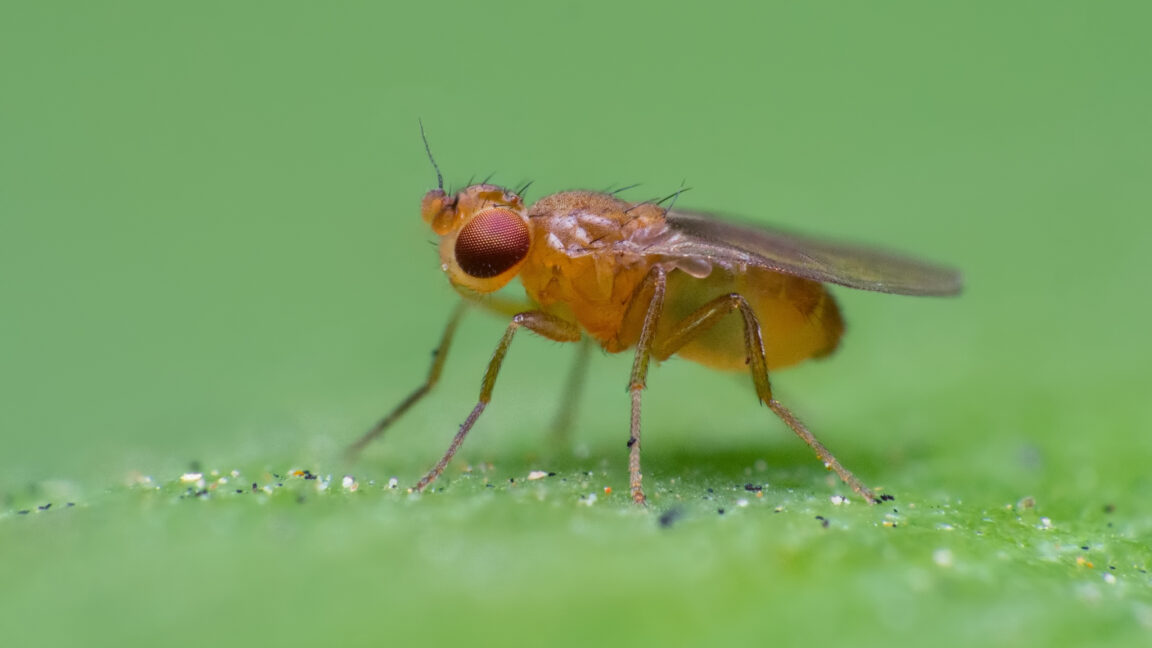
AI-generated summary based on reports from arstechnica.comInstaBriefs does not carry out original reporting. Every fact below is traceable to the sources listed with this story.
30-second brief
Researchers at Rockefeller University found that fruit flies navigate invisible odor trails using advanced cognitive mechanisms rather than basic hardwired reflexes.
One-minute read
Scientists at Rockefeller University, led by neuroscientist Vanessa Ruta, have uncovered how fruit flies navigate chaotic odor plumes to locate food and mates. Biologists previously believed flies relied on a simple 'surge and cast' reflex—flying upwind when catching a scent and weaving side-to-side when losing it. However, new findings show that fruit flies engage in far more complex processing to manage sparse, shifting chemical cues carried by turbulent air. By using controlled laboratory setups such as fly treadmills, researchers are gaining new insights into how tiny insect brains solve intricate navigation challenges.
Why this matters
Understanding how tiny brains solve complex spatial and sensory problems helps neuroscientists learn more about neural processing, bio-inspired robotics, and autonomous navigation systems.
Background
For decades, the standard scientific model for insect olfactory navigation was 'surge and cast,' which posited that insects responded automatically to odor Whiffs without higher-level processing.
Key terms
- Surge and cast
- A biological theory suggesting insects fly straight upwind when detecting a scent (surge) and search side-to-side when the scent disappears (cast).
- Olfactory navigation
- The process by which organisms use their sense of smell to determine direction and locate physical targets.
Structured analysis built only from the verified reports behind this story.
AI analysis based on reports from arstechnica.com. Not original reporting.
Key facts
- Scientists at Rockefeller University, led by neuroscientist Vanessa Ruta, have uncovered how fruit flies navigate chaotic odor plumes to locate food and mates.
- Biologists previously believed flies relied on a simple 'surge and cast' reflex—flying upwind when catching a scent and weaving side-to-side when losing it.
- However, new findings show that fruit flies engage in far more complex processing to manage sparse, shifting chemical cues carried by turbulent air.
- By using controlled laboratory setups such as fly treadmills, researchers are gaining new insights into how tiny insect brains solve intricate navigation challenges.
Fruit flies rely on odor plumes carried through turbulent air to navigate toward food sources or potential mates. Because wind swirls these chemical signals into intermittent and chaotic filaments mixed with clean air, understanding how flies locate odor sources with tiny brains has long posed a challenge for scientists.
Historically, biologists attributed this behavior to a simplified "surge and cast" reflex model. Under this concept, insects were thought to fly directly upwind upon detecting an odor signal and sweep side-to-side to relocate the plume whenever the sensory signal was lost.
New research led by neuroscientist Vanessa Ruta at Rockefeller University indicates that fruit flies employ a significantly more advanced navigation mechanism. The study addresses the limitations of the traditional reflex model, which struggles to explain how flies track sparse and unpredictable chemical trails across long distances.
Studying olfactory navigation in natural settings remains complex because invisible odors are constantly dispersed by turbulent airflow. Researchers used specialized experimental setups, including fly treadmills, to observe how the insects process fluctuating olfactory signals in real time.
Source attribution
Reported by 1 verified source· 1 verified outlet
Every brief lists the reporting it was written from.
- First published
- 1 Aug, 10:00
- Latest update
- 1 Aug, 10:00
- Confidence
- Medium
Based on how many independent verified outlets reported this story and whether their accounts agree.
- arstechnica.com
Verified outlet
Story timeline
How this story developed, oldest report first.
Study Reveals How Fruit Flies Track Complex Odor Trails
arstechnica.com
arstechnica.com
Tags
science · neuroscience · biology · fruit flies · research
This brief was written by AI from reported sources and reviewed against our editorial policy.
Related briefs

Study Challenges Prevailing Theory on Bonnethead Shark Head Development
A new research study focusing on bonnethead sharks in Florida has disproven a prior hypothesis regarding how distinct head shapes form in males and females, offering new clarity on the species' biological traits.

Cairo University Updates Egypt's Wild Plant Mapping After 15 Years
Cairo University's Faculty of Science has completed a major project updating Egypt's botanical map for the first time in 15 years. The initiative aims to safeguard wild plants as vital genetic resources for national food security.

Scientists Develop Catalyst to Convert CO₂ into Ethanol
A research team led by Professor Hyoyoung Lee at Sungkyunkwan University has developed an advanced catalyst that converts carbon dioxide into ethanol with high selectivity using electric current.

Homo Antecessor Skull Fragments Offer New Insights into Cranial Structure
A scientific study analyzing three parietal fragments from the Gran Dolina site in Spain provides quantitative data on cranial vault thickness in Homo antecessor, suggesting skull layers resemble those of modern humans and Neanderthals.
Discussion (0)
Discussion0 comments
Sign in to join the discussion.
No comments yet. Start the discussion.